
Halifax County Criminal Court Cases
Halifax County criminal cases are divided by court level. Halifax General District Court hears misdemeanors and traffic matters. It also handles arraignments and preliminary hearings for felonies. A felony that is certified or indicted moves to Halifax Circuit Court, the trial court for felony pleas, trials, judgments, and sentencing. The Circuit Court also hears misdemeanor appeals. Juvenile and domestic matters belong to J&DR District Court, where most juvenile records have strict access limits.
Virginia towns do not run a separate municipal court tier. A South Boston or Town of Halifax police charge still enters Halifax General District Court. The arresting agency keeps its own police report, but the clerk creates and maintains the criminal case file. That split matters. A request for an officer's narrative goes to the police agency, while an indictment, plea order, disposition, or certified judgment goes to the court clerk.
The official General District Court page shows how Halifax County criminal court cases are routed. Its captured court selector makes the county choice clear.
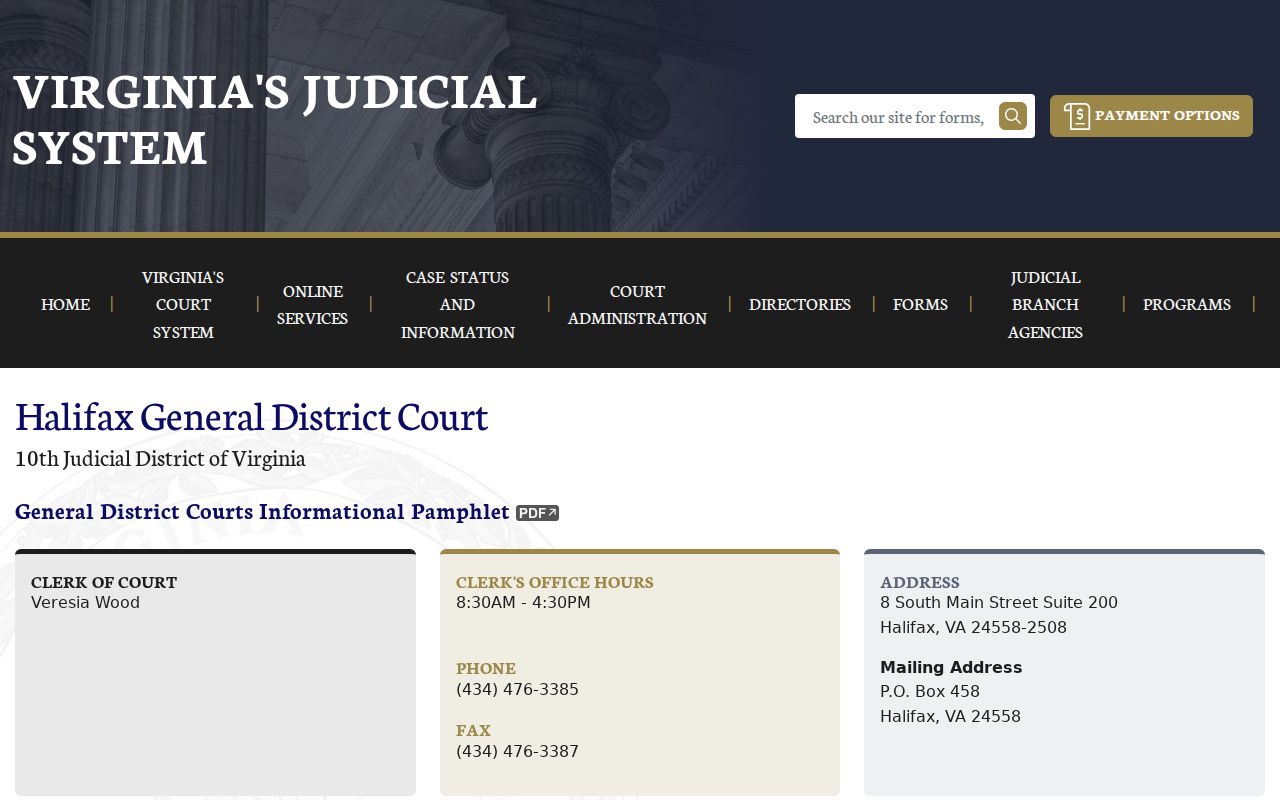
That court page is also the best source for current contacts and docket timing before a records request.
Halifax Felony Case Record Cycle
Halifax Circuit Court belongs to Virginia's 10th Judicial Circuit. Its term and grand-jury day falls on the first Thursday of each month. That local rhythm helps explain gaps between a General District Court entry and a new Circuit Court file. Certification after a preliminary hearing does not itself create a conviction. It means the felony process is moving toward Circuit Court, where a grand jury may return an indictment and the court may later receive a plea or conduct a trial.
The official Halifax Circuit Court page identifies the clerk, court schedule, location, and mailing instructions.
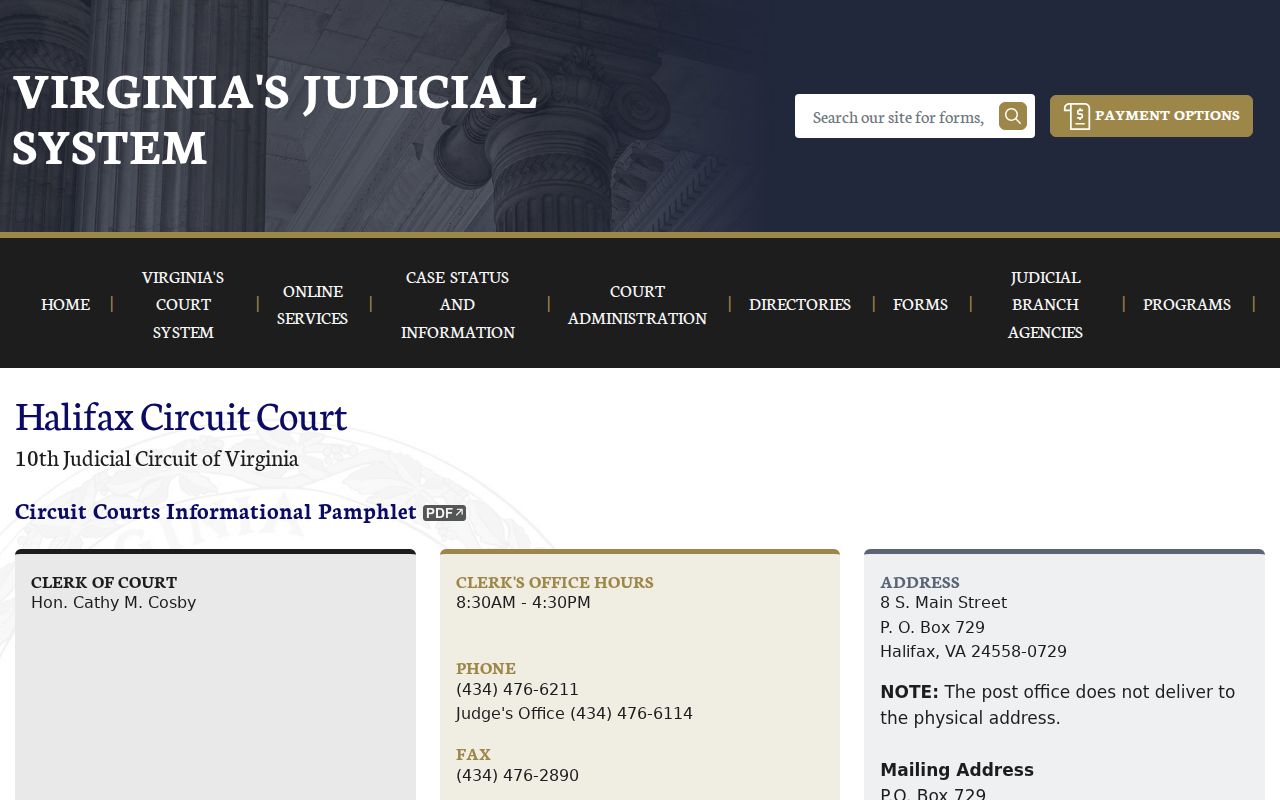
The monthly cycle is useful context, but the case docket and entered orders control the status of any one case.
Searching Halifax County Case Records
The Virginia Judiciary case-information gateway routes readers to Statewide Online Case Information, Circuit Court Case Information, and the court-by-court General District Court system. Online entries are free to view. Coverage depends on the participating court and when staff enter the event. The tools are indexes and status systems, not a complete set of scanned pleadings.
- Choose the likely court. Use Halifax General District Court for misdemeanors and early felony events, or Circuit Court for indicted and final felony matters.
- Select Halifax as the locality, then search by defendant name, exact case number, or hearing date.
- Compare the charge, arresting agency, case status, and dates to avoid joining records for people with similar names.
- Read each docket event and disposition. Follow a certified felony into Circuit Court instead of treating certification as the final outcome.
- Give the correct clerk the case number when requesting a pleading, sentencing order, certified disposition, or older file.
| Field or control | Type | Required | Use in Halifax |
|---|---|---|---|
| Court | Dropdown | Yes | Select Halifax General District Court for district matters. |
| Search method | Tabs or links | Yes | Choose name, case number, or hearing date. |
| Name | Text | Method-based | Use the defendant role for criminal cases. |
| Case number | Text | Method-based | Best when the exact identifier is known. |
| Hearing date | Date | Method-based | Useful for the published agency dockets. |
The Judiciary gateway shows the official routes to each public case tool.
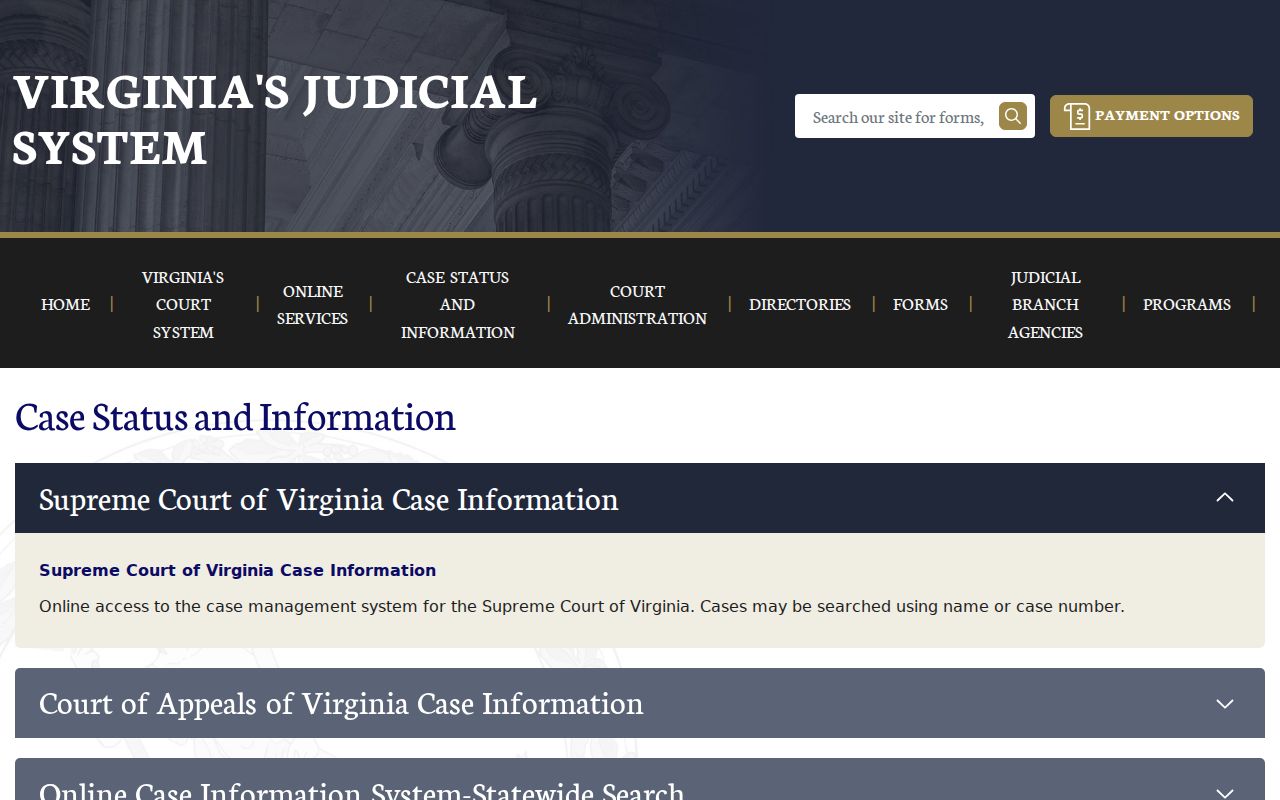
Starting at the gateway reduces the risk of using the wrong court level or an unofficial records source.
Halifax Criminal Court Docket Days
Halifax General District Court publishes an unusually detailed agency schedule. South Boston police matters appear on the first four Mondays at set morning and afternoon times. Sheriff's matters are called Tuesdays, while felony preliminary hearings sit Tuesday afternoons. State Police matters are heard Thursdays. Town of Halifax police matters appear on the first Friday. Other weekly slots cover agencies such as conservation police, Virginia ABC, Forestry, Parks, Animal Control, and ASAP.
The schedule can help identify the likely agency or hearing date when a person lacks a case number. It cannot prove that a case will be heard on a given day, since continuances and calendar changes occur. Confirm the live docket through the clerk or court system. The official GDC court selector is the direct starting point.
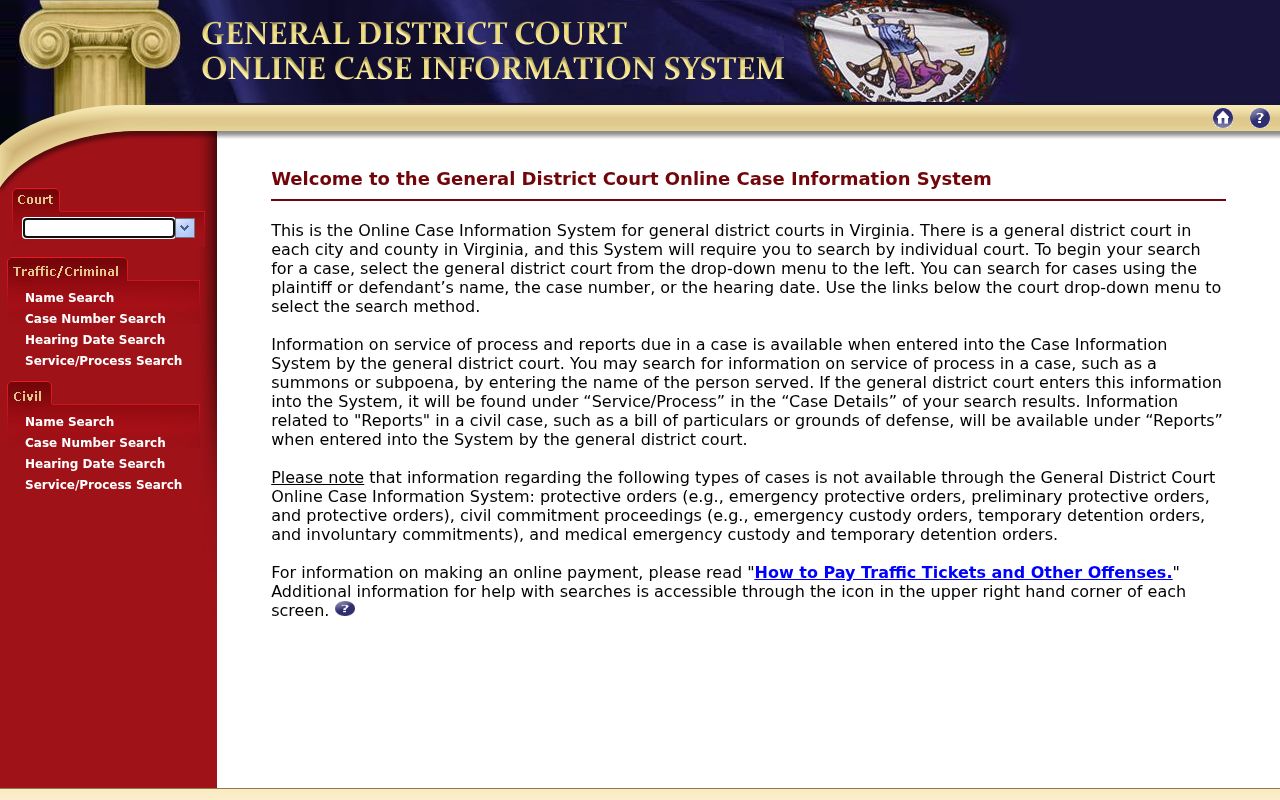
The selector links local agency days to the correct state court, rather than a nonexistent municipal court.
Inside a Halifax County Case File
A public online entry can identify a Halifax County criminal case, but the clerk's file carries the legal record. Header fields often show locality, court, case number, type, status, and key dates. Charge data may include the description, Virginia statute or crime code, offense level, arresting agency, and process number. Event history can show arraignment, continuance, preliminary hearing, waiver, certification, grand-jury action, plea, trial, disposition, and sentencing.
| Case number and court | Identifies the locality, file, and court level that presently holds the matter. |
|---|---|
| Charging document | May be a complaint, warrant, indictment, or another formal accusation. |
| Docket entries | List hearings, continuances, motions, pleas, trial events, and entered orders. |
| Charge details | Can include description, statute or VCC, level, offense date, and arresting agency. |
| Disposition and judgment | States the outcome for each charge, such as guilty, dismissed, or nolle prosequi. |
| Sentence and conditions | May show jail time, suspended time, fines, costs, probation, and other public terms. |
Documents and certified copies usually require clerk access. Online metadata is not an authenticated copy, and it may not include attachments, signed orders, or every protected field.
Reading Halifax Criminal Case Outcomes
Three terms often lead to wrong conclusions. Certified means a felony moved from General District Court toward Circuit Court. It is not a finding of guilt. Nolle prosequi means the prosecutor chose not to proceed with the charge at that time. It is not a conviction. A dismissal ends the charge without a conviction, though it does not automatically erase the arrest or every related record.
- Disposition
- The recorded outcome of a charge or case.
- Indictment
- A grand jury's formal felony accusation.
- Capias
- A court order directing that a person be taken into custody, often after nonappearance or an alleged violation.
- Deferred disposition
- A Virginia process that postpones a final outcome under statutory conditions in an eligible matter.
For a record correction or an expungement inquiry, obtain the certified disposition rather than relying on a search-screen label. The clerk can tie the order to the exact Halifax County case number and charge.
How a Criminal Case Moves
A misdemeanor can begin and finish in General District Court. A felony normally begins there with an arraignment and preliminary process, then moves to Circuit Court after certification or indictment. The Commonwealth's Attorney handles prosecution, while each clerk records the events within that court's jurisdiction. A plea or trial leads to a disposition, and a guilty judgment can lead to sentencing and supervision terms.
Case flow: Charges Filed › Arraignment › Pretrial › Plea or Trial › Disposition › Sentencing
This flow describes court records, not the separate arrest report or jail booking file. A reader following the charge should check both court levels when the General District Court entry says certified or waived to Circuit.
Halifax Criminal Records Clerk Counter
Circuit Clerk Cathy M. Cosby's office is the destination for felony indictments, signed judgments, sentencing orders, misdemeanor appeals, and certified Circuit Court records. The counter is at 8 South Main Street in Halifax and operates from 8:30 a.m. to 4:30 p.m. The main telephone is (434) 476-6211. Mail must go to P.O. Box 729, Halifax, VA 24558 because the court warns that the post office does not deliver to the physical address.
General District Clerk Veresia Wood's office handles misdemeanor files and the early felony record. It is at 8 South Main Street, Suite 200, with mail to P.O. Box 458. The telephone is (434) 476-3385, and public hours are 8:30 a.m. to 4:30 p.m. Ask either clerk for the current copy and certification price before ordering because an official Halifax criminal-copy fee was not published in the reviewed sources.
Halifax Circuit Court Clerk
8 S. Main St.
Mail: P.O. Box 729
Halifax, VA 24558
(434) 476-6211
Halifax General District Court
8 S. Main St., Suite 200
Mail: P.O. Box 458
Halifax, VA 24558
(434) 476-3385
Case Record Access & Restrictions
Virginia court dockets are broadly searchable, but openness has limits. Protective orders, civil commitments, and medical emergency custody or temporary detention matters are excluded from the public GDC online system. Juvenile criminal-history information is restricted under Virginia Code § 19.2-389.1. Sealed matters, victim identifiers, medical details, and other protected data may be withheld or redacted.
Virginia Code § 2.2-3704 governs public-record request mechanics, but court access and criminal-history dissemination also depend on record-specific law. The criminal-history dissemination statute controls CCRE information. A missing online result can mean the wrong court, delayed entry, an older file, or a lawful restriction. Contact the clerk before drawing a conclusion.
Halifax Court File Versus CCRE
A Halifax County court file follows one matter in one court. It may show pleadings, hearings, lawyers, charge changes, judgment, sentence, and costs. A Virginia State Police CARE/CCRE history instead links reported arrest cycles and dispositions across the state. It depends on agency and court reporting and does not replace the full pleading file.
Use the clerk when the goal is to understand a specific case or obtain a certified result. Use the VSP SP-167 process for an official Virginia name-based record. The SP-167 requires notarized subject consent, costs $15 per name, is mailed to VSP CARE, and has a published processing time of about 15 business days. VSP offers no expedited or same-day service. For a broad view of county record channels, the Halifax County criminal history overview explains how court, police, jail, and repository files differ.
Statewide Online Case Information provides the official statewide search interface for participating courts.
The statewide index is useful for case discovery, while the Halifax clerk remains the source for certified documents.